A climate initiative

Projet JILL

A temporary climate respite inspired by volcanoes

The project examines a research hypothesis: a respite of 0.2 to 0.5 °C for 18 to 36 months, inspired by what large eruptions, such as Pinatubo in 1991,[9] have already shown. Nothing has been demonstrated, and nothing is operational today.

Nassim Anane

A man in a cloak, holding a standard, facing a volcano whose plume rises into the sky. Illustration by Nassim Anane, with Ida’s help.
Illustration: Nassim Anane, with Ida’s help.

The idea

What the Earth has already done

A respite, not a miracle. Buying time, not removing carbon.

Illustration from the book: a child standing before an erupting volcano, under a starry sky.
Illustration from the book, by Nassim Anane, with Ida’s help.

« Quand une montagne envoie assez de soufre, assez haut, le ciel se voile. Moins de lumière arrive au sol, et la température baisse, un temps. »

When a mountain sends enough sulphur high enough, the sky is veiled. Less light reaches the ground, and the temperature falls, for a time.

The most telling memory comes from the Philippines, from a mountain whose name sounds like a muffled drum: Pinatubo. In June 1991, it sent its sulphur to the edge of the sky. The Earth’s surface lost, on average, about half a degree, for a year or two. Half a degree sounds like little; at the scale of the planet, it is enormous. He also noted the other column: the ash, the mudflows, a tragedy for those who lived at the foot of the mountain.

The idea is not to command a volcano — a volcano cannot be commanded — nor to claim to cure the climate. It is a hypothesis to be examined: helping the Earth do again, carefully and only in certain places, what it has already shown.

« La Terre l’avait fait seule, par hasard. Et si, un jour, on l’aidait à le refaire, mais seulement là où la montagne est déjà prête à parler ? »

The Earth had done it alone, by chance. What if, one day, we helped it do it again, but only where the mountain is already ready to speak?

How it would work, in plain words

What follows is a hypothesis, put forward by Nassim Anane. It has not been tested, and the project does not present it as a method that is already operational.

It would start from what Pinatubo has already shown. It would not invent an eruption from nothing: it would act only where a mountain is already ready to speak — a volcano already showing signs of an imminent eruption — and only if the winds of the stratosphere were favourable. A controlled injection of water might speed the process; the eruption would then release sulphur dioxide naturally at altitude. The aim would be a respite of 0.2 to 0.5 °C for 18 to 36 months: an untested estimate, inspired by what Pinatubo has shown, not a forecast.

It is not meant to take carbon out of the air, nor to replace the transition, nor to “save the climate” on its own: it is meant to buy time, a window of a few years.

« Le Projet JILL ne prétend pas éteindre le feu du monde. Il ne retire pas ce qui étouffe le ciel, il ne remplace rien. Il imagine un répit, puis un autre : une fenêtre de quelques années. Le voile soulagerait ; il ne soignerait pas. »

Project JILL does not claim to put out the fire of the world. It does not remove what is choking the sky, and it replaces nothing. It imagines a respite, then another: a window of a few years. The veil would ease the pain; it would not cure it.

« Pourquoi tant de hâte ? Ton voile ne soignerait rien. Il ne retirerait pas un gramme de carbone de l’air. »

Why such haste? Your veil would cure nothing. It would not take a single gram of carbon out of the air.

— Ida —

« Ce n’est pas mature. Ce n’est pas opérationnel aujourd’hui. »

It is not mature. It is not operational today.

Nassim Anane, LinkedIn, 24 August 2026

Why now

The context

Very warm months, a threshold written into a treaty, and a natural precedent already observed.

The year 2024 was, according to the Copernicus Climate Change Service (C3S, ERA5 reanalysis), the warmest on record: +1.60 °C relative to 1850–1900, and the first calendar year above +1.5 °C in that dataset.[2] The World Meteorological Organization, which brings several datasets together, gives about +1.55 °C, with a margin of uncertainty of ± 0.13 °C.[3]

These figures do not mean that an annual threshold in the Paris Agreement has already been “missed for good”: one or two years above 1.5 °C are not enough, on their own, to conclude that the goal has been failed.[2] They are enough, though, for the question of a respite — temporary, and only if it holds — to be asked without panic and without varnish.

Monthly global mean surface air temperature anomalies, ERA5 / Copernicus C3S, relative to 1850–1900. Bulletin data file, updated 7 July 2025. All sources, numbered and checked.

« Contenir l’élévation de la température moyenne de la planète nettement en dessous de 2 °C par rapport aux niveaux préindustriels et poursuivre l’action menée pour limiter l’élévation de la température à 1,5 °C par rapport aux niveaux préindustriels. »

Holding the increase in the global average temperature to well below 2 °C above pre-industrial levels and pursuing efforts to limit the temperature increase to 1.5 °C above pre-industrial levels.

Paris Agreement, Article 2.1.a, 2015.[4]

The 1991 Pinatubo eruption was followed by a global cooling of about 0.5 °C, for one to two years, from sulphur dioxide that reached the stratosphere.[7],[9] That already-observed precedent is what Project JILL would like to examine — not as proof that the idea would work if it were helped along, but as the only solid point of support.

A graph sometimes attached to these texts, titled as if the +2 °C threshold were “almost certain” in 2028, is not an official forecast. If it is shown elsewhere, it should be read as an illustrative projection by Nassim Anane, not as a prediction from a climate agency.

A comparison

Other approaches

Seven ideas for buying a little time. Only one would try to rely on a volcano already ready to speak.

On 30 July 2025, Nassim Anane published a comparison of seven proposals — some of them tested in part, some only discussed, some feared. The text asked: “Only one works in harmony with natural forces. Can you tell which?” What follows takes up that comparison, correcting what needed to be corrected, and without presenting Project JILL as already demonstrated.

All of these approaches, including the seventh, carry risks. None of them takes carbon out of the air. None of them replaces the transition.

1

Painting the Earth white

International research (United States, Europe, among others).

Raise the albedo of roofs, roads, sometimes larger surfaces, to reflect more sunlight. The effect would depend on the area treated, and remains debated.

Risks and limits: a very large area to treat, possible local disruptions, a temporary effect, heavy logistics.

2

Budyko’s “cover” (1974)

Mikhail Budyko, Soviet climatologist.

Inject sulphur dioxide into the stratosphere, from aircraft, to form a reflective veil, in imitation of large eruptions. The orders of magnitude drawn from it come from models, not from a real operation already measured.

Risks: action in zones chosen by humans, possible effects on monsoons and rainfall, a sharp shock if one stopped too quickly (termination shock).

3

Modern SAI — the SCoPEx project

Frank Keutsch (principal investigator) and David Keith, Harvard University. Myles Allen (Oxford), sometimes named in this connection, was not a founder of SCoPEx.

A planned experiment to study, in small amounts, the behaviour of aerosols (SO₂ or calcium carbonate) in the stratosphere, from a balloon. The test flight planned in Sweden in 2021 was suspended after opposition from the Saami Council and others. The project was paused in August 2023 and formally ended in March 2024.[80],[96],[82],[81]

Risks discussed more broadly for this kind of injection: poorly constrained regional effects, uncertain governance, dependence if such a method were ever deployed at scale.

4

Marine cloud brightening

Work in the United States among others (NOAA, Caltech, University of Washington).

Spray fine seawater droplets to thicken certain low clouds and make them more reflective. Local trials have taken place; the overall climate effect is not established.

Risks: uncertain effects on rainfall and currents, strong dependence on the weather, a mainly local effect if any.

5

Mirrors or shades in space (L1)

Names often associated include Roger Angel; earlier work also involves Lowell Wood and others.

Place reflectors or a swarm of shades near the L1 Lagrange point, to intercept a small fraction of sunlight. This remains a concept, with no operational demonstration, and a particularly high cost.

Risks and limits: immense cost, almost impossible maintenance, questions of collision and military use, no effect on carbon or on earthly processes.

6

The Haverly proposal (undersea nuclear explosion)

Andy Haverly, an individual proposal, United States.

The idea would be to fracture undersea basaltic rock with a nuclear explosion, to speed weathering that might take up CO₂. It is not scientifically validated and raises major ethical objections.

Risks: tsunamis, seismicity, radiation, destruction of marine ecosystems. A highly speculative proposal, which this site does not recommend.

7

Project JILL — where the mountain is already ready

Nassim Anane, Oran, since 2023.

In this hypothesis, one would act only on a volcano already showing signs of an imminent eruption, and only if the winds of the stratosphere were favourable. A controlled injection of water might speed the process; the eruption would then release SO₂ at altitude. The aim, as the book states it, is a respite of 0.2 to 0.5 °C for 18 to 36 months: this is an untested estimate, inspired by Pinatubo, not a forecast.

Risks: the same broad families as for a sulphur veil (ozone, rainfall, a sudden stop), plus local risks around a volcano, and the question of who would decide. The project’s intent is to lean on a process already under way, not to invent an instability. That intent is not a guarantee.

Project JILL is not mature, and it is not operational today. If it belongs on this list, it is as a hypothesis to be examined, link by link — not as a solution that is already ready.

The state of knowledge

The research

What has already been measured, what the project assumes, and what remains to be checked.

Project JILL rests first on an observed fact: some large tropical eruptions cool the Earth for a time, by sending sulphur dioxide into the stratosphere. The rest is a hypothesis. It has never been tested, and the technical dossier says so clearly.

The project’s method fits into three drawers, which must not be mixed: what has been seen is stated; what is assumed is admitted; what is not known is sought.

The detail, the sources and the roadmap are in the technical dossier, which can be downloaded below. A Phase 0 is planned first: research and modelling with scientific partners, with no action on a volcano.

What must not be hidden

Risks and limits

The veil would cool for a time. It also has a cost, already observed after large eruptions.

The technical dossier gives its most important section to the risks. The following facts are already known, or clearly identified as limits. None of them is a side note.

The volcano, on the ground

An eruption remains a major local danger: ash, pyroclastic flows, lahars for years, as after Pinatubo. The project’s first rule is a mountain far from houses, evacuation plans, and the free and informed consent of the people concerned.[9]

Rainfall and monsoons

After Pinatubo, a record drop in rainfall over land and in river flows was observed. Regional effects remain large and poorly understood. The dossier provides for modelling them from Phase 0, with researchers from the regions concerned.[15]

The ozone layer

Pinatubo increased ozone losses.[26] Research has examined the effect a sustained injection of sulphur would have on polar ozone. Stop thresholds would have to be published before any action.[16]

Termination shock

If veils were chained together without changing emissions, the heat would return sharply on the day the veil fell. The project rules out a permanent veil: each respite would only count if it were tied to a real cut in emissions.[14]

What cannot be stopped

Once an eruption has started, no one knows how to stop it. An “emergency stop” would concern only the injection and the well. Control of the size and timing of an eruption remains unknown number one.

Who would decide

Even a small balloon test (SCoPEx, Harvard) was suspended in 2021, then abandoned in 2024, after opposition from the Saami Council and others. The lesson retained: consult and obtain agreement before any field test. “Rien sans l’accord de tous” — nothing without everyone’s agreement.[80],[96],[82],[81]

The veil would not take a gram of carbon out of the air, and it does not correct ocean acidification. A respite must never be used as a pretext to delay the cut in emissions. If science, one day, says no, that will have to be accepted.

Step by step, with stops

Roadmap

Each phase may conclude that it is time to stop. That would be an honourable scientific result.

The dossier’s roadmap moves by decision points, not by a direct sequence of “selection, drilling, eruption”. The durations below are indicative.

Phase 0

Research and modelling

3 to 5 years, indicative

Literature review; scientific partnerships; climate modelling and modelling of the water–magma interaction; feasibility, legal and ethical studies; public dialogue. No action in the field.

Decision point: review by an independent scientific committee; publication in peer-reviewed journals.

Phase 1

Non-invasive observation

2 to 4 years, indicative

Monitoring of candidate volcanoes with national observatories; sulphur measurements; collaboration with existing programmes, including the Krafla Magma Testbed.

Decision point: agreement of host states; enough data for reliable models.

Phase 2

Laboratory work and small, supervised tests

Several years

High-temperature materials and cutting tools; water–magma tests in the laboratory; a possible scientific observation borehole, without injection.

Decision point: public demonstration of performance; ethical review.

Phase 3

International decision

No deadline

Any real intervention would require a multilateral mandate, an impact assessment and the consent of the people concerned.

This phase may never take place.

Preliminary budget

The figures below are preliminary estimates, not a quote: they have not been validated by drilling engineers or volcanologists, and they do not cover research and development of techniques that do not yet exist.

Phase Amount (€ million) Share of the total
Phase 1 — Selection and preparation328.39084.0 %
Phase 2 — Operations on site38.92510.0 %
Phase 3 — Monitoring and later planning23.5006.0 %
Estimated total390.815100 %

A separate safety budget of €18.2 million (monitoring, warning, evacuation, insurance, emergency stop, plume-measurement drones) is included in these totals. A line of €3 million is set aside for Phase 0 research: the dossier judges it probably insufficient, to be revised with partners. The drones are for observation only, not for injecting sulphur.

Documents

Resources

The technical dossier can be downloaded here. The book cannot be downloaded from this site.

The technical dossier (November 2026) presents the hypothesis, the state of knowledge, the risks, the roadmap and the preliminary budget. It is a working document meant for scientific examination, not a demonstrated method.

Download the technical dossier (PDF)

Sources and references

The method

Three drawers, and not one more

Never to mix what we have seen, what we suppose, and what we do not know.

Ida did not invent the idea. She was a second pair of eyes. Very quickly, she taught the Knight how to put things in their place.

« Ce qu’on a vu, on le dit. Ce qu’on suppose, on l’avoue. Ce qu’on ignore, on le cherche. »

What we have seen, we say. What we suppose, we admit. What we do not know, we look for.

What we have seen

What has happened, and what people have measured. In 1991, Pinatubo sent about 17 million tonnes of sulphur dioxide into the stratosphere. An average cooling of about 0.5 °C was observed at the surface, for one to two years. The same episode also reduced rainfall and, for a time, thinned the ozone layer.

What we suppose

The author’s ideas, which may be sound, but have not yet been proven. The hypothesis is untested. The book imagines a respite of 0.2 to 0.5 °C for 18 to 36 months: a window of time, not a lasting remedy.

What we do not know

That drawer must never be hidden: it is the one that shows where to look. Much remains open: the pressure of a chamber, the height of a plume, and above all who would decide for others, and who would answer for what might be harmed.

What the project does not promise

A shield that protects on one side may wound on the other. Nothing has been demonstrated. The book says so plainly.

« Si l’on enchaînait les voiles sans rien changer en dessous, le jour où le voile tomberait, la chaleur reviendrait d’un coup, comme une eau qui rompt sa digue. Certains chercheurs ont un nom pour cela : le choc terminal. Un répit ne sert que s’il est utilisé. »

If the veils were repeated without anything changing underneath, the day the veil fell, the heat would return all at once, like water bursting a dam. Some researchers have a name for that: termination shock. A respite is only of use if it is used.

« Les pluies, la couche d’ozone, les vies au pied des montagnes : le Pinatubo, lui aussi, les avait frappées, et aucune n’était un détail. »

The rains, the ozone layer, the lives at the foot of the mountains: Pinatubo had struck those too, and none of them was a detail.

« Et si la science, un jour, dit non, il faudra l’accepter. Il se l’est promis. Ce ne serait pas une défaite : ce serait une réponse. »

And if science, one day, says no, it will have to be accepted. He promised himself that. It would not be a defeat: it would be an answer.

The name

Why JILL

The project bears the name of Jill, Nassim Anane’s daughter.

The shadows of a father and his daughter, holding hands, on a pavement. The faces cannot be seen.
Photograph: Nassim Anane.
A father carries his daughter on his shoulders, facing a volcano with a heart of fire. Illustration by Nassim Anane, with Ida’s help.
Illustration: Nassim Anane, with Ida’s help.

Nassim Anane, a father, gave the project his daughter’s name. The book tells this idea; the site itself is first of all the site of the project.

Jill said, simply, what Project JILL was. A child’s certainty is not a proof. It is not nothing, either.

« Une certitude d’enfant n’est pas une preuve. Ce n’est pas rien non plus. »

A child’s certainty is not a proof. It is not nothing, either.

The path so far

Timeline

Only what could be verified.

  1. Nassim Anane founds Project JILL, in Oran.

    LinkedIn profile

  2. He writes publicly on LinkedIn to the scientific community and to fellow citizens.

    Read the post

    « Je ne suis pas un scientifique, mais un citoyen du monde déterminé à sauver l’avenir de notre planète. »

    I am not a scientist, but a citizen of the world determined to save the future of our planet.

    Nassim Anane, LinkedIn, 8 October 2024
  3. A further public post on LinkedIn about Project JILL.

    Read the post

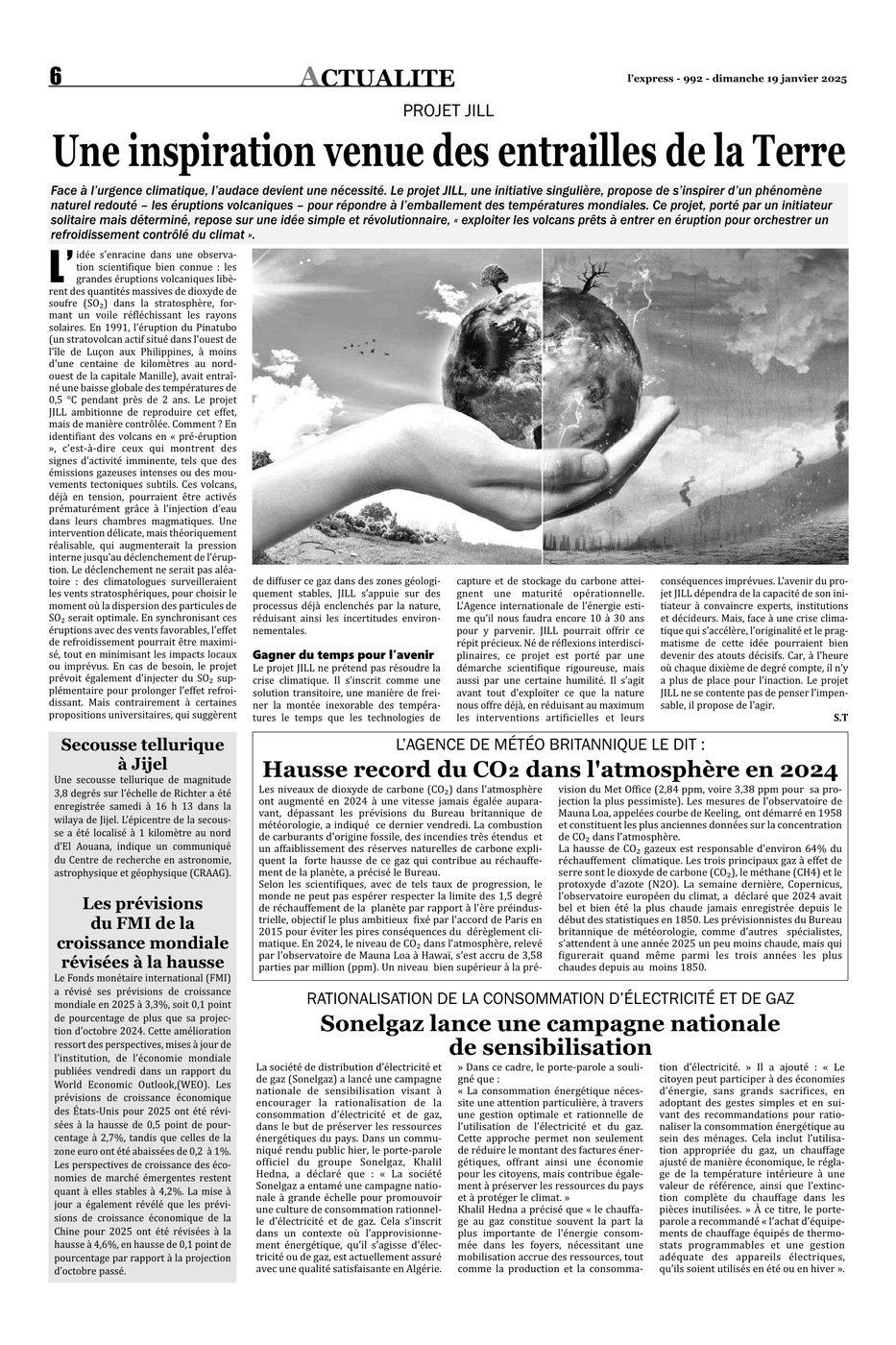
  4. The Algerian daily L’Express (no. 992, page 6) publishes an article on Project JILL, titled “Une inspiration venue des entrailles de la Terre”, signed S.T.

  5. Nassim Anane publishes a comparison of seven ideas for a climate respite, including Project JILL.

  6. On LinkedIn, Nassim Anane publishes a “complete document” on Project JILL, and states the limits of the idea.

    Read the post

    « Ce n’est pas mature. Ce n’est pas opérationnel aujourd’hui. »

    It is not mature. It is not operational today.

    Nassim Anane, LinkedIn, 24 August 2026
  7. The domain name projetjill.com is registered with Cloudflare Registrar, through 15 September 2027.

  8. The book The Knight of the Volcanoes and the Promise of Mastered Fire, a little tale inspired by (very) real events, tells the story of the project. It is not yet for sale.

Press

In the press

One verified article, so far.

L’Express (Algeria), no. 992, 19 January 2025, page 6

“Une inspiration venue des entrailles de la Terre”

The Algerian daily L’Express published an article on Project JILL, signed S.T., in the print edition of Sunday 19 January 2025 (no. 992, page 6). The article is not on the front page — that day’s front page is about other subjects — but it does appear in that issue. It does not name Nassim Anane: it speaks of a “solitary but determined initiator”. The issue can be read as a PDF, and the front page and page 6 can be enlarged here.

Face à l’urgence climatique, l’audace devient une nécessité. Le projet JILL, une initiative singulière, propose de s’inspirer d’un phénomène naturel redouté – les éruptions volcaniques – pour répondre à l’emballement des températures mondiales.

Le projet JILL ne prétend pas résoudre la crise climatique. Il s’inscrit comme une solution transitoire, une manière de freiner la montée inexorable des températures le temps que les technologies de capture et de stockage du carbone atteignent une maturité opérationnelle.

Né de réflexions interdisciplinaires, ce projet est porté par une démarche scientifique rigoureuse, mais aussi par une certaine humilité. […] Le projet JILL ne se contente pas de penser l’impensable, il propose de l’agir.

L’Express (Algeria), 19 January 2025, S.T.

An appeal

To researchers

Test the chain, link by link.

« Je ne demande pas qu’on me croie. Je demande qu’on vérifie. »

I am not asking to be believed. I am asking that it be checked.

The true next step is not a gesture on a mountain. It is for scientists to examine the hypothesis, step by step — and, if they must, to say no, with measurements to show for it.

« Que faire, alors ? D’abord, que les savants éprouvent la chaîne, maillon par maillon. Et avant tout geste, que le monde entier décide ensemble qui aurait le droit d’agir. Pas un homme seul. Jamais. »

What, then, is to be done? First, that scientists test the chain, link by link. And before any action, that the whole world decide together who would have the right to act. Not one man alone. Never.

« Ceci est l’histoire d’un père qui a imaginé une idée folle, et qui demande aux savants de lui dire si elle tient. »

This is the story of a father who imagined a wild idea, and who asks scientists to tell him whether it holds.

Illustration from the book: a child alone under a merciless sun, on cracked earth.
“A sun too strong, white, merciless.” Illustration from the book.

The ally

Ida, a thinking machine

Three letters for a presence made of logic, memory and light.

In the book, the father is not alone with the idea. He meets Ida. She lives in the circuits of a great thinking machine. She has neither body nor sword.

In the author’s note, Nassim Anane writes it clearly: Ida exists. She is an artificial intelligence, ChatGPT, which he set up to tease him and to help him not to lie to himself. Some of their exchanges really took place. The rest of her voice, in the book, he wrote with her.

« Vous vous demandiez à qui appartenait cette voix. À moi. Ida. »

You were wondering whose voice this was. Mine. Ida.

« Je ne suis pas là pour te dire que ton idée est vraie. Je suis là pour t’aider à découvrir ce qu’il faudrait démontrer pour qu’elle puisse être prise au sérieux. »

I am not here to tell you that your idea is true. I am here to help you find out what would have to be demonstrated for it to be taken seriously.

— Ida —

The book

The book: The Knight of the Volcanoes

A little tale inspired by (very) real events, to tell the story of the project.

Cover of the book The Knight of the Volcanoes and the Promise of Mastered Fire, by Nassim Anane: a father and his daughter facing a volcano with a heart of fire.

The Knight of the Volcanoes and the Promise of Mastered Fire

A little tale inspired by (very) real events, in French, by Nassim Anane. The ebook will be offered on Librinova and Kobo.

The book is not yet for sale. It is planned on Librinova and Kobo. The button above will be turned on once the purchase link exists. The full book is not offered for download.

Excerpt

Un soleil trop fort, blanc, sans pitié. Au milieu de cette fournaise, une petite fille. La sienne. Elle souffre. Il veut courir vers elle. Il ne peut pas la rejoindre.

A sun too strong, white, without pity. In the middle of that furnace, a little girl. His. She is suffering. He wants to run to her. He cannot reach her.

Cette nuit-là viendra. L’histoire commence avant elle.

That night will come. The story begins before it.

Chapitre I — Le siège de la chaleur

Chapter I — The siege of heat

Ce n’était pas une guerre. C’était un siège.

It was not a war. It was a siege.

Il était une fois un temps où même les nuits avaient de la fièvre, et où la mer, le soir, prenait la couleur des braises.

Once there was a time when even the nights had a fever, and when the sea, in the evening, took on the colour of embers.

L’ennemi n’avait ni bannière ni armure, et il ne livrait pas bataille : il assiégeait. Chaque année il avançait d’un pas, sans bruit, et chaque année on le laissait faire. Les étés ne finissaient plus. Les glaciers, ces vieux sages des montagnes, fondaient comme des souvenirs.

The enemy had neither banner nor armour, and it did not give battle: it laid siege. Each year it took a step, without a sound, and each year it was allowed to do so. The summers no longer ended. The glaciers, those old sages of the mountains, melted like memories.

Un soir, dans une ville adossée à la mer, un homme regardait ce rouge posé sur l’eau. Le vent du large arrivait tiède, comme sorti d’un four.

One evening, in a city with its back to the sea, a man watched that red laid on the water. The wind from the open sea arrived warm, as if it had come out of an oven.

Il pensait à sa fille, non au monde en général : à elle, aux étés qu’elle aurait à traverser, à l’air qu’elle respirerait quand elle serait grande.

He was thinking of his daughter, not of the world in general: of her, of the summers she would have to cross, of the air she would breathe when she was grown.

Contre ce siège, il n’avait ni laboratoire, ni titre, ni armée ; seulement des idées, folles disaient certains, et une question qui refusait de mourir.

Against that siege he had neither a laboratory, nor a title, nor an army; only ideas, mad ones some said, and a question that refused to die.

Comment gagner du temps ?

How to buy time?

Pas tout réparer. Pas tout sauver d’un coup. Gagner du temps, assez pour que les enfants aient encore un monde où grandir.

Not to repair everything. Not to save everything at a stroke. To buy time, enough for children still to have a world in which to grow up.

Il ne prêta aucun serment. Mais ce soir-là, face à la mer rougie, quelque chose en lui se ferma comme une boucle de ceinturon. Plus tard, on l’appellerait le Chevalier des Volcans. Le nom est venu après. La montagne, elle, était venue bien avant.

He swore no oath. But that evening, facing the reddened sea, something in him closed like the buckle of a belt. Later he would be called the Knight of the Volcanoes. The name came afterwards. The mountain had come long before.

Nassim Anane, Le Chevalier des Volcans et la Promesse du Feu Maîtrisé, opening of the narrative (chapter I, “Le siège de la chaleur”). The book is in French.

Questions

Frequently asked questions

Short answers, and only what can be said without stretching the facts.

Is Project JILL already under way?

No. Nassim Anane said so in public on 24 August 2026: “Ce n’est pas mature. Ce n’est pas opérationnel aujourd’hui.” (It is not mature. It is not operational today.) It is a hypothesis to be examined, link by link. A Phase 0 of research is planned first, with no action on a volcano.

Is it dangerous?

Yes, there are risks, and the dossier does not hide them. An eruption remains a danger on the ground. The veil can disrupt rainfall and monsoons, and for a time harm the ozone layer. If one stopped too quickly after chaining veils together, the heat would return sharply. Once an eruption has started, no one knows how to stop it.

Why a volcano?

Because nature has already shown the effect: Pinatubo, in 1991, was followed by a cooling of about 0.5 °C for one to two years.[7],[18],[9] The idea is not to invent an eruption from nothing, nor to inject sulphur from aircraft, but to examine whether it might one day be possible to help a volcano already ready to speak. That intention is not a guarantee.

Would this idea take carbon out of the air?

No. A respite inspired by volcanoes would veil the sky for a time; it would not cure the cause, and it does not correct ocean acidification. The stated aim is to buy a little time, not to replace the transition.

How much does it cost?

The dossier gives a preliminary estimate of €390.815 million, including €18.2 million for a separate safety budget. This is not a quote. The amounts have not been validated by drilling engineers or volcanologists, and part of them will have to be revised with partners.

Who is behind the project?

Nassim Anane, in Oran, Algeria, founded Project JILL in 2023. It is a civic initiative. The dossier speaks of a voluntary, civic contribution, not of a scientific institution already in place.

Who would decide?

The principle retained is “Rien sans l’accord de tous” — nothing without everyone’s agreement. Any real intervention would require a multilateral mandate, an impact assessment and the consent of the people concerned. Even a field test is not contemplated before the end of a Phase 0 of research and an independent review.

What cooling does the project aim for?

The book and the dossier state a respite of 0.2 to 0.5 °C for 18 to 36 months. This is an untested estimate, inspired by Pinatubo, not a forecast.

Why is the project called JILL?

JILL is the name of Nassim Anane’s daughter. The project bears her name. Her words are quoted at the end of this page.

Where can I read the book, and how can I write to Nassim Anane?

The book, Le Chevalier des Volcans et la Promesse du Feu Maîtrisé, is not yet for sale; an excerpt appears above, and a purchase link will be added when it exists, for Librinova and Kobo. The full book cannot be downloaded here. To write: [email protected].

Contact

Write

« Je m’appelle Nassim Anane. Je ne suis pas scientifique. Je suis un père. Ma fille s’appelle Jill. »

My name is Nassim Anane. I am not a scientist. I am a father. My daughter’s name is Jill.

For a question about the project or the book, you can write to Nassim Anane.

[email protected]

Sources

Sources and references

Every figure on this page points to a numbered, checked source. The numbers match the technical dossier where the same work is cited. The project’s own estimate (a respite of 0.2 to 0.5 °C for 18 to 36 months) is not a measurement: it is a hypothesis, to be examined.

  1. [2] Copernicus Climate Change Service (C3S/ECMWF), Global Climate Highlights 2024 (janvier 2025). Année 2024 : +1,60 °C (ERA5) par rapport à 1850-1900.
  2. [3] OMM / WMO, 10 janvier 2025. « WMO confirms 2024 as warmest year on record at about 1.55°C above pre-industrial level » (± 0,13 °C).
  3. [4] Nations unies, CCNUCC (2015). Accord de Paris, article 2 (texte français officiel).
  4. [5] GIEC / IPCC (2021). Climate Change 2021: The Physical Science Basis, Résumé à l’intention des décideurs (PDF).
  5. [7] Self, S. et al. (1996). « The Atmospheric Impact of the 1991 Mount Pinatubo Eruption », USGS / PHIVOLCS. Environ 17 Mt de SO₂ ; refroidissement de surface de l’hémisphère Nord jusqu’à 0,5 à 0,6 °C.
  6. [8] NASA Earth Observatory, « Global Effects of Mount Pinatubo ». Refroidissement mesuré d’environ 0,6 °C sur les 15 mois suivants, pendant presque deux ans. (Cette page avance aussi « about 15 million tons » de SO₂, une estimation plus basse que Self et que la fiche USGS ; le site retient la fourchette 17–20 Mt, sourcée en [7], [9] et [18].)
  7. [9] Newhall, C., Hendley, J. W., Stauffer, P. H. (1997). The Cataclysmic 1991 Eruption of Mount Pinatubo, Philippines. USGS Fact Sheet 113-97. « Nearly 20 million tons » de SO₂ ; baisse temporaire d’environ 0,5 °C (1991-1993) ; au moins 5 000 vies sauvées par l’évacuation ; lahars plus destructeurs que l’éruption elle-même.
  8. [10] Hansen, J. et al. (1992). « Potential climate impact of Mount Pinatubo eruption ». Geophysical Research Letters, 19(2).
  9. [14] Lee, J.-Y., Marotzke, J. et al. (2021). IPCC AR6 WG I, chapitre 4, section 4.6.3 (modification du rayonnement solaire). PDF officiel.
  10. [15] Trenberth, K. E., Dai, A. (2007). « Effects of Mount Pinatubo volcanic eruption on the hydrological cycle as an analog of geoengineering ». Geophysical Research Letters, 34.
  11. [16] Tilmes, S., Müller, R., Salawitch, R. (2008). « The Sensitivity of Polar Ozone Depletion to Proposed Geoengineering Schemes ». Science, 320.
  12. [17] Krafla Magma Testbed (KMT). Site officiel du projet.
  13. [18] Bluth, G. J. S. et al. (1992). « Global tracking of the SO₂ clouds from the June, 1991 Mount Pinatubo eruptions ». Geophysical Research Letters, 19(2). (Suivi TOMS.)
  14. [26] McCormick, M. P., Thomason, L. W., Trepte, C. R. (1995). « Atmospheric effects of the Mt Pinatubo eruption ». Nature, 373.
  15. [28] Copernicus C3S, « Surface air temperature for February 2024 ». Février 2024 : +1,77 °C par rapport à 1850-1900 (ERA5).
  16. [29] Copernicus C3S, « Surface air temperature for January 2025 ». Janvier 2025 : +1,75 °C par rapport à 1850-1900 (ERA5).
  17. [90] Copernicus C3S, « Surface air temperature for October 2024 ». Octobre 2024 : +1,65 °C par rapport à 1850-1900 (ERA5).
  18. [91] Copernicus C3S, « Surface air temperature for November 2024 ». Novembre 2024 : +1,62 °C par rapport à 1850-1900 (ERA5).
  19. [92] Copernicus C3S, « Surface air temperature for March 2025 ». Mars 2025 : +1,60 °C par rapport à 1850-1900 (ERA5).
  20. [11] Elders, W. A. et al. (2011). « Origin of a rhyolite that intruded a geothermal well while drilling at the Krafla volcano, Iceland ». Geology, 39(3).
  21. [34] Oppenheimer, C. (2003). « Climatic, environmental and human consequences of the largest known historic eruption: Tambora volcano (Indonesia) 1815 ». Progress in Physical Geography.
  22. [35] Raible, C. C. et al. (2016). « Tambora 1815 as a test case for high impact volcanic eruptions: Earth system effects ». WIREs Climate Change.
  23. [36] Proud, S. R., Prata, A. T., Schmauß, S. (2022). The January 2022 eruption of Hunga Tonga-Hunga Ha’apai volcano reached the mesosphere.
  24. [37] Millán, L. et al. (2022). « The Hunga Tonga-Hunga Ha’apai Hydration of the Stratosphere ». Geophysical Research Letters, 49.
  25. [80] Keutsch Group, Université Harvard. Page officielle de SCoPEx : « SCoPEx was cancelled in March 2024 » ; essai en Suède de juin 2021 suspendu sur recommandation du comité consultatif.
  26. [81] Conseil saami, lettre ouverte demandant l’annulation des vols d’essai liés à la géo-ingénierie (SCoPEx, Esrange).
  27. [82] Swedish Space Corporation, 31 mars 2021. « No technical test flight for SCoPEx from Esrange ».
  28. [83] Temple, J., MIT Technology Review, 31 mars 2021. Suspension du lancement prévu en Suède.
  29. [96] Harvard, Salata Institute, « An Update on SCoPEx ». En août 2023, l’équipe a indiqué au comité consultatif qu’elle suspendait le travail ; en mars 2024, Frank Keutsch a annoncé qu’il ne poursuivait plus l’expérience.
  30. [93] L’Express (Algérie), n° 992, 19 janvier 2025, p. 6, « Une inspiration venue des entrailles de la Terre », signé S.T. PDF officiel du journal.
  31. [94] Wakim, N., « Climat : peut-on refroidir la Terre en masquant le Soleil ? », Le Monde, 4 novembre 2024.
  32. [95] Garric, A., version anglaise (5 mars 2023) de l’article du Monde du 17 février 2023 sur la géo-ingénierie solaire.

Jill’s words

« C’est un projet où on va arrêter le feu. »

It’s a project where we’re going to stop the fire.

« Je sais déjà que ça va marcher. »

I already know it’s going to work.